Wednesday, July 30, 2008

HTML Tutorial

HyperText Markup Language, is the predominant markup language for web pages. It provides a means to describe the structure of text-based information in a document — by denoting certain text as links, headings, paragraphs, lists, and so on — and to supplement that text with interactive forms, embedded images, and other objects. HTML is written in the form of tags, surrounded by angle brackets. HTML can also describe, to some degree, the appearance and semantics of a document, and can include embedded scripting language code (such as JavaScript) which can affect the behavior of Web browsers and other HTML processors.

Useful Links:


Free Download Books(pdf):


Product Details

* Paperback: 569 pages
* Publisher: Osborne/McGraw-Hill; 1st edition (November 15, 2000)
* Language: English
* ISBN-10: 0072130261
* ISBN-13: 978-0072130263


Book Description
* HTML is the universal language for presenting content on the web.
* Every person seeking a job in the online industry MUST at least have HTML proficiency.
* Osborne's HTML: The Complete Reference has sold more than 40,000 copies--this book is the perfect companion.
* Written by a recognized industry trainer, Wendy Willard.

Download Description
Essential skills for first-time programmers! This easy-to-use book explains the fundamentals of HTML and Web development. The modular approach of this series--including drills, sample projects, and mastery checks--makes it easy to learn to use this powerful programming language at your own pace.

Book Info
Easy to use quick reference guide explains the fundamentals of HTML and Web development. Covers HTML. Softcover. --This text refers to an out of print or unavailable edition of this title.

From the Author
When I was first approached about writing this book, I must admit that my thought was, "another HTML book -- how many do we need?" I learned HTML by experience when there was only one version of Netscape, and it had been a long time since I’d even looked at an HTML book. But after I researched the other HTML books on the market, I felt compelled to write a book that gives readers a realistic, easy-to-understand approach to learning HTML, while at the same time offering real-world practice activities and advice on related issues. "HTML: A Beginner's Guide" is that book, offering you practical tools and knowledge that can easily be applied to a variety of development situations, without the boring rhetoric or lengthy technical fluff. This book tells you what you need to know, when you need to know it..."

From the Back Cover
Learn the basics of HTML programming from the tutorials and examples in this easy-to-follow guide. Inside, Web design expert Wendy Willard shows you how to plan the structure and navigation of your site, format Web pages, work with text, links, and color, and add graphics and multimedia to your site. You'll also learn to use related technologies, including JavaScript and Cascading Style Sheets (CSS). If you want to get started creating Web sites with HTML right away, this is the ideal self-paced learning tool for you.

This Beginner's Guide is Designed for Easy Learning:

* Modules - Each programming concept is divided into logical modules (chapters), ideal for individualized learning
* Goals - Each module opens with the specific programming skills you'll have by the end of the module
* Ask the Experts - Q&A sections throughout are filled with extra information and interesting commentary
* 1-Minute Drills - Quick self-assessment sections to check your progress
* Annotated Syntax - Example code annotated with commentary that points to the particular technique illustrated
* Projects - Coding exercises contained in each module show how to apply what you are learning
* Mastery Checks - end-of-module reviews that test your knowledge using short-answer, multiple-choice, fill-in-the-blank, and simple coding questions


Click here To Download


HTML4 Bible


Product Details

* Paperback: 743 pages
* Publisher: Wiley; 2 edition (January 15, 2000)
* Language: English
* ISBN-10: 0764534734
* ISBN-13: 978-0764534737

In HTML 4 Bible, you'll find a comprehensive definition of what is considered state of the art in Web-publishing languages. The book explains HTML tags and Cascading Style Sheets (CSS) thoroughly, and it gives some attention to JavaScript as well.

Authors Pfaffenberger and Gutzman use a helpful problem-and-solution format that provides straightforward answers to common problems--they show you how to build image maps and create attractive forms, to cite two examples.

What's special about the book's approach is that it doesn't get sidetracked by the universe of detail that HTML 4 presents. Rather than choosing to ploddingly document the characteristics of one tag after another, Pfaffenberger and Gutzman explain their subject by describing how it is applied in practice. They explain, for example, how to arrange textual data so that people are more likely to read it.

The downside to this holistic approach is that HTML 4 Bible isn't the absolutely comprehensive HTML reference many readers will expect it to be. Books like that exist, and you may want to supplement HTML 4 Bible with one of them. But if you want a text that provides informed explanations of how to get the results you want with HTML, this book is for you. --David Wall --This text refers to an out of print or unavailable edition of this title.

Product Description
HTML 4 Bible, 2nd Edition is your comprehensive reference to the latest standard for Web page construction. Build internet and intranet documents that are fully compliant with the rules of HTML 4.01, making them suitable for inclusion in xHTML applications. Once they're in xHTML, they can be integrated with SMIL, MathML, and SVG technologies to create full-featured Web applications.
The book's CD-ROM holds the Amaya, Internet Explorer, Netscape Communicator and Opera web browsers, allowing you to readily test your pages for cross-browser compliance. Also on the CD-ROM is TidyHTML, the best tool for validating your 4.01 source code.


Click Here To Download

XML Tutorial

Extensible Markup Language (XML) is a general-purpose specification for creating custom markup languages

XML is recommended by the World Wide Web Consortium (W3C). It is a fee-free open standard. The recommendation specifies both the lexical grammar and the requirements for parsing.

Useful Links:

Free Download Books(pdf files):


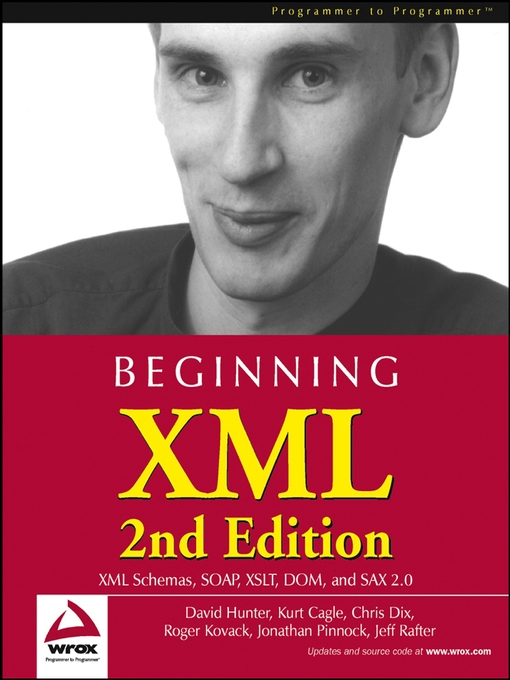
Beginning XML 2nd Edition


Product Details

* Paperback: 816 pages
* Publisher: Wrox; 2 edition (December 20, 2001)
* Language: English
* ISBN-10: 0764543946
* ISBN-13: 978-0764543944

Beginning XML provides a complete course in the Extensible Markup Language (XML) with an unusually gradual learning curve. In fact, the introduction states that the book is "for people who know that it would be a pretty good idea to learn the language, but aren't 100 percent sure why." Despite its recognition of the fuzziness of readers' understanding of the technology, the book delivers a rather comprehensive study of XML.

Very little space is wasted detailing the history of XML and its relation to SGML, as is the case in many other titles. The argument for the importance of XML is made quickly, and the basics of well-formed syntax are tackled right off. One notable distinction of this book is its excellent coverage of related technologies, such as cascading style sheets (CSS) and relational databases.

In addition to discussing the crucial companion standards to the core XML language (DTDs, XSL, and XSLT), the book adds a nice perspective to the broad range of applications in which XML can play a role. One section, "Other Uses for XML," illustrates how XML can be used to serialize object models, creating stateless objects and utilizing the Resource Description Framework (RDF). Case studies on--among other things--how XML can be used to build discussion groups, and provide B2B data transfer, round out the text. This book is perfect for Web programmers who are turning their attention to XML for the first time. It imparts a solid understanding of the XML forest and XML trees. --Stephen W. Plain

Click Here To download


XML By Example

Product Details

* Paperback: 425 pages
* Publisher: Que; 1 edition (December 14, 1999)
* Language: English
* ISBN-10: 0789722429
* ISBN-13: 978-8120316645

Amazon.com
XML by Example is a hands-on guide for those who already know the basics of HTML authoring but want a complete introduction to the exciting new world of XML. It lives up to its title, with plenty of examples of actual XML, HTML, JavaScript, and Java code. The author is an experienced trainer in XML and Internet technology, and the result is a particularly clear and well-informed tutorial.

Beginning with an overview of XML technology, the book goes on to explain XML syntax complete with a list of common errors and misunderstandings. Next comes an explanation of DTDs (Document Type Definitions) and then a guide to transforming XML into readable output with XSL (XML Stylesheet Language) and CSS (cascading style sheets). That accounts for the first half of the book. The second part focuses on the programmer's view of XML, with information on XML parsing, the DOM (Document Object Model), and SAX (Simple API for XML). Finally, there is a walkthrough of a multitier e-commerce application using XML and Java servlets. There is an appendix providing a crash-course introduction to Java.
Although it is aimed at XML newcomers, XML by Example covers a good bit of ground. Its fast pace makes it more demanding than some tutorials, but professionals will welcome its tight focus. A glossary and index round off the excellent handbook. --Tim Anderson, amazon.co.uk

Book Description
XML by Example teaches Web developers to make the most of XML with short, self-contained examples every step of the way. The book presumes knowledge of HTML, the Web, Web scripting, and covers such topics as: Document Type Definitions, Namespaces, Parser Debugging, XSL (Extensible Stylesheet Language), and DOM and SAX APIs. At the end, developers will review the concepts taught in the book by building a full, real-world e-commerce application.


Click Here To download

JAVA & XML

Click Here To Download

KickStart Tutorial XML

Click Here To Download

Friday, July 25, 2008

J2EE Tutorials

J2EE is a widely used platform for server programming in the Java programming language
The platform was known as Java 2 Platform, Enterprise Edition or J2EE until the name was changed to Java EE in version 5. The current version is called Java EE 5. The previous version is called J2EE 1.4.


Free Download J2EE Books(pdf):


Head First JSP & Servlet


Product Details

* Paperback: 886 pages
* Publisher: O'Reilly Media, Inc.; 1st edition (July 2004)
* Language: English
* ISBN-10: 0596005407
* ISBN-13: 978-0596005405

Product Description
Imagine a world without eBay...unthinkable! How would you get that Farrah Fawcett poster, retired Beanie Baby, or first-edition pet rock? Handling over a gazillion (OK, we exaggerate--it's actually only 1 billion) page views each day, server-side Java makes eBay work.

Isn't it time you learned the latest (J2EE 1.4) versions of Servlets & JSPs? This book will get you way up to speed on the technology you'll know it so well, in fact, that you can pass the Sun Certified Web Component Developer (SCWCD) 1.4 exam. If that's what you want to do, that is. Maybe you don't care about the exam, but need to use Servlets & JSPs in your next project. You're working on a deadline. You're over the legal limit for caffeine. You can't waste your time with a book that makes sense only AFTER you're an expert (or worse one that puts you to sleep).

No problem. Head First Servlets and JSP's brain-friendly approach drives the knowledge straight into your head (without sharp instruments). You'll interact with servlets and JSPs in ways that help you learn quickly and deeply. It may not be The Da Vinci Code, but quickly see why so many reviewers call it "a page turner". Most importantly, this book will help you use what you learn. It won't get you through the exam only to have you forget everything the next day.

Learn to write servlets and JSPs, what makes the Container tick (and what ticks it off), how to use the new JSP Expression Language (EL), what you should NOT write in a JSP, how to write deployment descriptors, secure applications, and even use some server-side design patterns. Can't talk about Struts at a cocktail party? That'll change. You won't just pass the exam, you will truly understand this stuff, and you'll be able to put it to work right away.

This new exam is tough--much tougher than the previous version of the SCWCD. The authors of Head First Servlets and JSP know: they created it. (Not that it EVER occurred to them that if they made the exam really hard you'd have to buy a study guide to pass it.) The least they could do is give you a stimulating, fun way to pass the thing. If you're one of the thousands who used Head First EJB to pass the SCWCD exam, you know what to expect!


Click Here To Download


java enterprise systems with j2ee


Click Here To Download


Java - J2EE Design Patterns Applied


Click Here To Download


J2EE-XML


Click Here To Download


Design Techniques Coding Standards for J2ee Projects


Click Here To Download


JAVA Tutorial

Java is a programming language originally developed by Sun Microsystems and released in 1995 as a core component of Sun Microsystems' Java platform.
Java applications are typically compiled to bytecode that can run on any Java virtual machine (JVM) regardless of computer architecture.


Free Download Books(pdf):


Product Details

* Paperback: 720 pages
* Publisher: O'Reilly Media, Inc.; 2 edition (February 9, 2005)
* Language: English
* ISBN-10: 0596009208
* ISBN-13: 978-0596009205

It has taken four years, but with Head First Java the introductory Java book category has finally come of age. This is an excellent book, far more capable than any of the scores of Java-for-novices books that have come before it. Kathy Sierra and Bert Bates deserve rich kudos--and big sales--for developing this book's new way of teaching the Java programming language, because any reader with even a little bit of discipline will come away with true understanding of how the language works. Perhaps best of all, this is no protracted "Hello, World" introductory guide. Readers get substantial exposure to object-oriented design and implementation, serialization, neatwork programming, threads, and Remote Method Invocation (RMI).

Key to the authors' teaching style are carefully designed graphics. Rather than explain class inheritance (to cite one example) primarily with text, the authors use a series of tree diagrams that clarify the mechanism far more succinctly. The diagrams are carefully annotated with arrows and notes. Also characteristic of the unique teaching strategy is heavy reliance on exercises, in which the reader is asked to complete partial classes, write whole new code segments and do design work. Though there's little discussion of why the exercises' correct answers are what they are, it's clear that the practice work was carefully designed to reinforce the lesson at hand. If you've waited this long to give Java a try, this book is a great choice. --David Wall
Topics covered: The Java programming language for people with no Java experience, and even people with no programming experience at all. Key concepts read like a list of Java features: Object oriented design, variable type and scope, object properties and methods, inheritance and polymorphism, exceptions, graphical user interfaces (GUIs), network connectivity, Java archives (JAR files), and Remote Method Invocation (RMI). --This text refers to an out of print or unavailable edition of this title.


Click Here To Download


JavaScript Complete Reference 2nd Edition


Product Details

* Paperback: 976 pages
* Publisher: McGraw-Hill Osborne Media; 2 edition (July 14, 2004)
* Language: English
* ISBN-10: 0072253576
* ISBN-13: 978-0072253573

Book Description
Create dynamic, interactive Web pages with the latest upgrade to this flexible development tool. Coverage includes event handling, object oriented programming, IE specific content, XML, and sample code that lets you work through projects and provides groundwork for your own creations. Provides information for new and non-professional developers and also more advanced coverage for experienced JS developers who want a comprehensive reference.

From the Back Cover

The Definitive JavaScript Resource. Complete coverage of the W3C DOM2 standard

Build dynamic, cross-browser Web pages using JavaScript--the premier client-side scripting language in use today on the Web. First learn the basics of the language, then combine syntax and theory to develop practical applications--create a variety of windows including special dialogs, use the W3C Document Object Model (DOM) 2 to manipulate (X)HTML documents, add sizzle to your pages with special effects, and improve usability. With full coverage of advanced topics such as using embedded objects and remote JavaScript, this is the ultimate resource for beginning and advanced users alike.

* Learn core language features such as data types, objects, and regular expressions
* Manipulate (X)HTML and XML documents using the W3C DOM 2
* Take advantage of the standard event models in DOM 2 for robust event handling
* Control windows and frames with the Windows object
* Validate forms before sending them to server-side programs
* Add dynamic effects to Web pages, such as rollovers and animation
* Extend JavaScript’s capabilities using embedded multimedia objects
* Interact with servers on the Internet using remote JavaScript
* Understand JavaScript security policies
* Troubleshoot and debug your JavaScript programs


Click here To Download


Head First Java Script


Product Details

* Paperback: 650 pages
* Publisher: O'Reilly Media, Inc. (January 11, 2008)
* Language: English
* ISBN-10: 0596527748
* ISBN-13: 978-0596527747

Product Description
So you're ready to make the leap from writing HTML and CSS web pages to creating dynamic web applications. You want to take your web skills to the next level. And you're finally ready to add "programmer" to the resume. It sounds like you're ready to learn the Web's hottest programming language: JavaScript. Head First JavaScript is your ticket to going beyond copying and pasting the code from someone else's web site, and writing your own interactive web pages.

With Head First JavaScript, you learn:

* The basics of programming, from variables to types to looping
* How the web browser runs your code, and how you can talk to the browser with your code
* Why you'll never have to worry about casting, overloading, or polymorphism when you're writing JavaScript code
* How to use the Document Object Model to change your web pages without making your users click buttons

If you've ever read a Head First book, you know what to expect -- a visually rich format designed for the way your brain works. Head First JavaScript is no exception. It starts where HTML and CSS leave off, and takes you through your first program into more complex programming concepts -- like working directly with the web browser's object model and writing code that works on all modern browsers.

Don't be intimidated if you've never written a line of code before! In typical Head First style, Head First JavaScript doesn't skip steps, and we're not interested in having you cut and paste code. You'll learn JavaScript, understand it, and have a blast along the way. So get ready... dynamic and exciting web pages are just pages away.

About the Author
Michael Morrison is a writer, developer, toy inventor, and author of a variety of books covering topics such as Java, Web scripting, game development, and mobile devices. Some of Michael's notable writing projects include JavaScript Bible, 6th Edition (Wiley, 2006),Teach Yourself HTML and CSS in 24 Hours, 7th Edition (Sams Publishing, 2005), Beginning Mobile Phone Game Programming (Sams Publishing, 2004) and Java Unleashed (Sams Publishing, 1997). Michael is the intructor of several Web-based courses, including DigitalThink's Introduction to Java 2 series, JavaBeans for Programmers series, and Win32 Programming series (www.digitalthink.com).

In addition to his primary profession as a writer and technical consultant, Michael is the founder of Stalefish Labs (www.stalefishlabs.com), an entertainment company specializing in games, toys, and interactive media. When not glued to his computer, skateboarding, playing hockey, or watching movies with his wife, Masheed, Michael enjoys hanging out by his koi pond.


Click Here To Download

c# Tutorial

c# is an object-oriented programming language developed by Microsoft as part of the .NET initiative.
C# is intended to be suitable for writing applications for both hosted and embedded systems, ranging from the very large that use sophisticated operating systems, down to the very small having dedicated functions.


Free Download Books(pdf):


Head First C#


Product Details

* Paperback: 778 pages
* Publisher: O'Reilly Media, Inc. (November 26, 2007)
* Language: English
* ISBN-10: 0596514824
* ISBN-13: 978-0596514822


The type of the release is: eBook
In the PDF format with ISBN: 0596514824 and Pub Date: November 26, 2007
The size of the release is: 28 disks x 5.00mb
And released on: 03/10/2008


Thanks my friend for supply that great book!

Head First C# is a complete learning experience for object-oriented
programming, C#, and the Visual Studio IDE. Built for your brain, this
book covers Visual C# 2008, Visual Studio 2008, and the .NET Framework
3.5, and teaches everything from language fundamentals to advanced
topics including garbage collection, extension methods, and
double-buffered animation. You'll also master C#'s hottest and newest
syntax, LINQ, for querying your data in .NET collections, SQL databases,
and more. By the time you're through, you'll be a proficient Visual C#
designing and coding large-scale applications. Every few
chapters you will come across a lab that lets you apply what you've
learned up to that point. Each lab is designed to simulate a
task, increasing in complexity until-at
last-you build a working Invaders game, complete with shooting ships,
aliens descending while firing, and an animated death sequence for
unlucky starfighters. This remarkably engaging book will have you going
from zero to 60 with Visual C# in no time flat.


Click Here To Download


C#: The Complete Reference


Product Details

* Paperback: 933 pages
* Publisher: Osborne/McGraw-Hill (March 8, 2002)
* Language: English
* ISBN-10: 0072134852
* ISBN-13: 978-0072134858

From Library Journal
NET and one of its programming languages, C#, are slowly becoming more popular. Learn To Program teaches C# to beginners with no programming experience, moving through the process of developing a real-world application as a class project. From ascertaining user needs through auditing results, it demonstrates application development. In Chapter 1, the author shows how to design and build on familiar concepts rather than jump into coding basic programs. Allowing readers to simulate the classroom experience and learn more naturally, Learn To Program is recommended where C and C++ titles circulate. Teach Yourself is a more traditional self-study guide for beginners with some programming experience. It opens with a description of C#'s attributes and a demonstration of writing and compiling a basic "Hello, World!" program, before building up to more advanced topics. Chapter Q&As, quizzes, and exercises and weekly reviews aid understanding, and useful appendixes contain keywords, command-line compiler flags, and number systems. For medium and larger libraries. More thoroughly serving intermediate programmers, Complete Reference is the only one of these three to ask readers to purchase Visual Studio .NET. Appendixes address XML comments and robotics, and example source code is available online.

Book Description
Learn everything you need to know about Microsoft’s new programming language for the .NET platform. Programming guru and best-selling author Herb Schildt presents not only code but valuable insight into best programming practices, so you can implement C# effectively.


Click Here To Download


Distributed .NET Programming in C#


Product Details

* Paperback: 494 pages
* Publisher: Apress (May 29, 2002)
* Language: English
* ISBN-10: 1590590392
* ISBN-13: 978-1590590393

Product Description

With the release of .NET, Microsoft has once again altered the distributed programming landscape. Almost everything has changed, from data access, to remote object calls, to the deployment of software components. And of course, .NET introduces a new technology in XML Web services that may revolutionize Web development.

Distributed .NET Programming in C# describes how to use these new .NET technologies to build fast, scalable, and robust distributed applications. Along the way, it answers common questions such as, How do I use the .NET Remoting Framework? What role does COM+ play in the .NET universe? How can I interoperate with COM components? What's the difference between .NET Remoting and Web services? How will these changes affect the architecture and design of a distributed application?

Author Tom Barnaby assumes the reader is already familiar with the fundamentals of .NET. However, a .NET overview is provided to concisely explain several of the core .NET technologies that are essential for distributed programming, including building, versioning, and deploying assemblies; garbage collection; serialization; and attribute-based programming.


Download Description

With the release of .NET, Microsoft has once again altered the distributed programming landscape. Almost everything has changed, from data access to remote object calls to the deployment of software components. And of course, .NET introduces a new technology in XML Web services that may revolutionize Web development.

Distributed .NET Programming in C# describes how to use these new .NET technologies to build fast, scalable, and robust distributed applications. Along the way, it answers common questions such as, How do I use the .NET Remoting Framework? What role does COM+ play in the .NET universe? How can I interoperate with COM components? What’s the difference between .NET Remoting and Web services? How will these changes affect the architecture and design of a distributed application?

Tom Barnaby assumes the reader is already familiar with the fundamentals of .NET. However, a .NET overview is provided to concisely explain several of the core .NET technologies that are essential for distributed programming, including building, versioning, and deploying assemblies; garbage collection; serialization; and attribute-based programming.


Click Here to Download


The FORTRAN Programming Language


One of the oldest programming languages,is a general-purpose, procedural, imperative programming language that is especially suited to numeric computation and scientific computing. the FORTRAN was developed by a team of programmers at IBM led by John Backus, and was first published in 1957. The name FORTRAN is an acronym for FORmula TRANslation, because it was designed to allow easy translation of math formulas into code.

useful links:


Euphoria programming language

is a simple, flexible, and easy-to-learn programming language. It lets you quickly and easily develop programs for Windows, DOS, Linux and FreeBSD.
was first released in 1993.
it is extremely fast. People use it to develop Windows GUI programs, high-speed DOS games, and Linux/FreeBSD X Windows programs. It is also very useful for CGI (Web-based) programming.

useful links:

Wednesday, July 23, 2008

CVS

CSS

Cascading Style Sheets (CSS) is a stylesheet language used to describe the presentation of a document written in a markup language. Its most common application is to style web pages written in HTML and XHTML, but the language can be applied to any kind of XML document, including SVG and XUL.

CSS can be used locally by the readers of web pages to define colors, fonts, layout, and other aspects of document presentation. It is designed primarily to enable the separation of document content (written in HTML or a similar markup language) from document presentation (written in CSS). This separation can improve content accessibility, provide more flexibility and control in the specification of presentation characteristics, and reduce complexity and repetition in the structural content (such as by allowing for tableless web design)


Free Download Books(pdf):

Head First HTML with CSS and XHTML


Learn the real secrets of creating Web pages, and why everything your boss told you about HTML tables is probably wrong (and what to do instead). Most importantly, hold your own with your co-worker (and impress cocktail party guests) when he casually mentions how his HTML is now strict, and his CSS is in an external style sheet.


With Head First HTML with CSS & XHTML, you'll avoid the embarrassment of thinking web-safe colors still matter, and the foolishness of slipping a font tag into your pages. Best of all, you'll learn HTML and CSS in a way that won't put you to sleep. If you've read a Head First book, you know what to expect: a visually-rich format designed for the way your brain works. Using the latest research in neurobiology, cognitive science, and learning theory, this book will load HTML, CSS, and XHTML into your brain in a way that sticks.


Click Here To Download

CORBA

CGI Tutorial


Free Download Books(pdf):


CGI Programming with Perl


Product Details

* Paperback: 451 pages
* Publisher: O'Reilly Media, Inc.; 2 edition (January 15, 2000)
* Language: English
* ISBN-10: 1565924193
* ISBN-13: 978-1565924192

Amazon.com
The appearance of the second edition of CGI Programming with Perl heralds the beginning of the neoclassical era of Web service. CGI--or common gateway interface--is the original back end for client-driven, dynamic Web-page service and deserves consideration as the Romulus of the Internet Empire. But, where first-edition author Gundavaram described the lonely Romulus laying the brick foundation of dynamic Web-page service in 1996, second-edition collaborators Guelich and Birznieks have pitched in to resurrect Romulus amid the crowded streets of modern Rome. Why bother? Surely four years have brought technological revolutions (Java, PHP, ASP, ColdFusion) that render CGI's original brick-by-brick approach as obsolete as, say, Roman mythology--or bricks and mortar.

And yet not. It is an ambiguous blessing that the original CGI persists, adhering to the underside of Web service by the duct tape that is Perl. This point is not missed by Guelich, Gundavaram, and Birznieks, whose advocacy of CGI is both bolstered by the growing applications module base of Perl and tempered by their awareness of CGI's structural limitations. Both new and returning readers of CGI Programming with Perl should browse the last chapter first in order to appreciate the proposed solutions to CGI's greatest sin: its impractical slowness in a world of a million-hits-per-day Web service. The chapter describes CGI-compatible FastCGI and mod_perl technologies that circumvent the process-spawning slowness of the simple CGI. Advanced users might want to skip directly to O'Reilly's fine mod_perl tome, Writing Apache Modules with Perl and C, by Lincoln Stein and Doug MacEachern.

The authors' second pass at CGI pedagogy is a lucid, honest, and expanded account that develops functionality of dynamic Web pages in a rational progression--from HTML client-server and CGI syntax basics to general input/output, forms, e-mail, graphics, and simple database applications, including maintaining client state and data persistence under the otherwise stateless HTTP protocol. The authors offer synopses of cookies, JavaScripting, server security, and XML, all of which are described in detail in other books.

Whether or not neoclassical CGI is fast enough for your purposes--perhaps for guarded intranets--bear in mind that CGI is the standard to which every other Web server has had to respond. The second edition of CGI Programming with Perl is still the best introduction to the classics. --Peter Leopold

Book Description
Programming on the Web today can involve any of several technologies, but the Common Gateway Interface (CGI) has held its ground as the most mature method--and one of the most powerful ones--of providing dynamic web content. CGI is a generic interface for calling external programs to crunch numbers, query databases, generate customized graphics, or perform any other server-side task. There was a time when CGI was the only game in town for server-side programming; today, although we have ASP, PHP, Java servlets, and ColdFusion (among others), CGI continues to be the most ubiquitous server-side technology on the Web. CGI programs can be written in any programming language, but Perl is by far the most popular language for CGI. Initially developed over a decade ago for text processing, Perl has evolved into a powerful object-oriented language, while retaining its simplicity of use. CGI programmers appreciate Perl's text manipulation features and its CGI.pm module, which gives a well-integrated object-oriented interface to practically all CGI-related tasks. While other languages might be more elegant or more efficient, Perl is still considered the primary language for CGI. CGI Programming with Perl, Second Edition, offers a comprehensive explanation of using CGI to serve dynamic web content. Based on the best-selling CGI Programming on the World Wide Web, this edition has been completely rewritten to demonstrate current techniques available with the CGI.pm module and the latest versions of Perl. The book starts at the beginning, by explaining how CGI works, and then moves swiftly into the subtle details of developing CGI programs. Topics include:

* Incorporating JavaScript for form validation
* Controlling browser caching
* Making CGI scripts secure in Perl
* Working with databases
* Creating simple search engines
* Maintaining state between multiple sessions
* Generating graphics dynamically
* Improving performance of your CGI scripts


Click Here To Download

c++ Tutorial


C++ is a general-purpose programming language.C++ is regarded as a middle-level language, as it comprises a combination of both high-level and low-level language features.
Bjarne Stroustrup developed C++ in 1979 at Bell Labs as an enhancement to the C programming language and named it "C with Classes". In 1983, it was renamed to C++. Enhancements started with the addition of classes, followed by, among other features, virtual functions, operator overloading, multiple inheritance, templates, and exception handling.


some useful links:


Free Download Books(pdf):


C/C++ Programmer's Reference by Herbert Schildt


Product Details

* Paperback: 384 pages
* Publisher: McGraw-Hill Osborne Media; 3 edition (December 24, 2002)
* Language: English
* ISBN-10: 0072227222
* ISBN-13: 978-0072227222

Book Description
Like having a brain in your back pocket. Provides clear explanations of all C and C++ programming syntax, keywords, commands, functions, and class libraries. Since no programmer can remember the precise syntax of every C/C++ element, this quick-access guide assists programmers in implementing efficient solutions on demand.


Click Here To Download


Object Oriented Programming


Product Details

* Paperback: 1040 pages
* Publisher: Sams; 4 edition (December 29, 2001)
* Language: English
* ISBN-10: 0672323087
* ISBN-13: 978-0672323089

Product Description

Object-Oriented Programming in C++ begins with the basic principles of the C++ programming language and systematically introduces increasingly advanced topics while illustrating the OOP methodology. While the structure of this book is similar to that of the previous edition, each chapter reflects the latest ANSI C++ standard and the examples have been thoroughly revised to reflect current practices and standards.

Educational Supplement

Suggested solutions to the programming projects found at the end of each chapter are made available to instructors at recognized educational institutions. This educational supplement can be found at www.prenhall.com, in the Instructor Resource Center.


Download Description
Object-Oriented Programming in C++ begins with the basic principles of the C++ programming language and systematically introduces increasingly advanced topics while illustrating the OOP methodology. While the structure of this book is similar to that of the previous edition, each chapter reflects the latest ANSI C++ standard and the examples have been thoroughly revised to reflect current practices and standards.


Click Here To Download

C Programming Language

C is a general-purpose, block structured, procedural, imperative computer programming language developed in 1972 by Dennis Ritchie at the Bell Telephone Laboratories.

It was named "C" because many of its features were derived from an earlier language called "B", which according to Ken Thompson was a stripped-down version of the BCPL programming language.


Useful links:


Free download Books(pdf):

The C Programming Language 2nd Edition


Product Details

* Paperback: 274 pages
* Publisher: Prentice Hall PTR; 2 edition (April 1, 1988)
* Language: English
* ISBN-10: 0131103628
* ISBN-13: 978-0131103627

Just about every C programmer I respect learned C from this book. Unlike many of the 1,000 page doorstops stuffed with CD-ROMs that have become popular, this volume is concise and powerful (if somewhat dangerous) -- like C itself. And it was written by Kernighan himself. Need we say more?

Book Info
Describes C as defined by the ANSI standard. Meant to help the reader learn how to program in C. Examples included. Paper. DLC: C (Computer program language)

The publisher, Prentice-Hall ECS Professional
This second editon describes C as defined by the ANSI standard. This book is meant to help the reader learn how to program in C. The book assumes some familiarity with basic programming concepts like variables, assignment statements, loops, and functions. A novice programmer should be able to read along and pick up the language.

From the Inside Flap
Preface

The computing world has undergone a revolution since the publication of The C Programming Language in 1978. Big computers are much bigger, and personal computers have capabilities that rival the mainframes of a decade ago. During this time, C has changed too, although only modestly, and it has spread far beyond its origins as the language of the UNIX operating system.

The growing popularity of C, the changes in the language over the years, and the creation of compilers by groups not involved in its design, combined to demonstrate a need for a more precise and more contemporary definition of the language than the First edition of this book provided. In 1983, the American National Standards Institute (ANSI) established a committee whose goal was to produce "an unambiguous and machine-independent definition of the language C," while still retaining its spirit. The result is the ANSI standard for C.

The standard formalizes constructions that were hinted at but not described in the first edition, particularly structure assignment and enumerations. It provides a new form of function declaration that permits cross-checking of defini-tion with use. It specifies a standard library, with an extensive set of functions for performing input and output, memory management, string manipulation, and similar tasks. It makes precise the behavior of features that were not spelled out in the original definition, and at the same time states explicitly which aspects of the language remain machine-dependent.

This second edition of The C Programming Language describes C as defined by the ANSI standard. Although we have noted the places where the language has evolved, we have chosen to write exclusively in the new form. For the most part, this makes no significant difference; the most visible change is the new form of function declaration and definition. Modern compilers already support most features of the standard.

We have tried to retain the brevity of the first edition. C is not a big language, and it is not well served by a big book. We have improved the exposition of critical features, such as pointers, that are central to C programming. We have refined the original examples, and have added new examples in several chapters. For instance, the treatment of complicated declarations is augmented by programs that convert declarations into words and vice versa. As before, all examples have been tested directly from the text, which is in machine-readable form.

Appendix A, the reference manual, is not the standard, but our attempt to convey the essentials of the standard in a smaller space. It is meant for easy comprehension by programmers, but not as a definition for compiler writersÑ that role properly belongs to the standard itself. Appendix B is a summary of the facilities of the standard library. It too is meant for reference by programmers, not implementers. Appendix C is a concise summary of the changes from the original version.

As we said in the preface to the first edition, C "wears well as one's experience with it grows." With a decade more experience, we still feel that way. We hope that this book will help you to learn C and to use it well.Brian W. Kernighan, Dennis M. RitchiePreface to the First Edition

C is a general-purpose programming language which features economy of expression, modern control flow and data structures, and a rich set of operators. C is not a "very high level" language, nor a "big" one, and is not specialized to any particular area of application. But its absence of restrictions and its generality make it more convenient and effective for many tasks than

supposedly more powerful languages.

C was originally designed for and implemented on the UNIX operating sys-tem on the DEC PDP-1 1, by Dennis Ritchie. The operating system, the C compiler, and essentially all UNIX applications programs (including all of the software used to prepare this book) are written in C. Production compilers also exist for several other machines, including the IBM System/370, the Honeywell 6000, and the Interdata 8/32. C is not tied to any particular hardware or system, however, and it is easy to write programs that will run without change on any machine that supports C.

This book is meant to help the reader learn how to program in C. It contains a tutorial introduction to get new users started as soon as possible, separate chapters on each major feature, and a reference manual. Most of the treatment is based on reading, writing and revising examples, rather than on mere statements of rules. For the most part, the examples are complete, real programs, rather than isolated fragments. All examples have been tested directly from the text, which is in machine-readable form. Besides showing how to make

effective use of the language, we have also tried where possible to illustrate useful

algorithms and principles of good style and sound design.

The book is not an introductory programming manual; it assumes some familiarity with basic programming concepts like variables, assignment statements, loops, and functions. Nonetheless, a novice programmer should be able to read along and pick up the language, although access to a more knowledgeable colleague will help.

In our experience, C has proven to be a pleasant, expressive, and versatile language for a wide variety of programs. It is easy to learn, and it wears well as one's experience with it grows. We hope that this book will help you to use it well.Brian W. Kernighan, Dennis M. Ritchie

Back Cover Copy
This book is meant to help the reader learn how to program in C. It is the definitive reference guide, now in a second edition. Although the first edition was written in 1978, it continues to be a worldwide best-seller. This second edition brings the classic original up to date to include the ANSI standard.

From the Preface:

We have tried to retain the brevity of the first edition. C is not a big language, and it is not well served by a big book. We have improved the exposition of critical features, such as pointers, that are central to C programming. We have refined the original examples, and have added new examples in several chapters. For instance, the treatment of complicated declarations is augmented by programs that convert declarations into words and vice versa. As before, all examples have been tested directly from the text, which is in machine-readable form.

As we said in the first preface to the first edition, C "wears well as one's experience with it grows." With a decade more experience, we still feel that way. We hope that this book will help you to learn C and use it well.

About the Author

Brian W. Kernighan works in the Computing Science Research Center at Bell Laboratories, Lucent Technologies. He is Consulting Editor for Addison-Wesley's Professional Computing Series and the author, with Dennis Ritchie, of The C Programming Language.

Dennis Ritchie is a computer scientist notable for his influence on ALTRAN, B, BCPL, C, Multics, and Unix.

Click Here To Download


Let Us C by Yashavant Kanetkar


Product Details

* Paperback
* Publisher: BPB Publications; 5Rev Ed edition (November 30, 2004)
* ISBN-10: 8176569402
* ISBN-13: 978-8176569408

The 8th updated edition of a classic considered a foundation work in C programming is now available, and any college-level or technical library strong in C programming will find the new edition has been extensively edited, revised, and updated, complete with a CD-ROM added with more examples. From hundreds of step-by-step examples and exercises for self-study to a basic coverage focusing on both the latest techniques and introductory material for beginners, LET US C is a reference any computer library must have.

This was the first book that got me started off on C programming, and I would strongly recommend it, provided you don't mind overlooking the author's limited lingual skills and choice of words. (That's the only reason I have rated this with 4 stars instead of a full five.) The best parts of the book are the short concise examples, followed by some really interesting exercises: I would recommend that you do each and every problem listed in the exercises, since they help the beginner programmer to immediately apply the concepts learned, and thus permanently internalize them. The exercises themselves are very interesting and challenging and let you test your mettle.


All in all, a very good _beginner_ level book to begin your career in C programming.
Click Here To download


Objective C Pocket Reference


Product Details

* Paperback: 128 pages
* Publisher: O'Reilly Media, Inc.; 1st edition (December 1, 2002)
* Language: English
* ISBN-10: 0596004230
* ISBN-13: 978-0596004231

Product Description
Objective-C is an exciting and dynamic approach to ibased object-oriented programming; it's the approach adopted by Apple as the foundation for programming under Mac OS X, a Unix-based operating system gaining wide acceptance among programmers and other technologists. Objective-C is easy to learn and has a simple elegance that is a welcome breath of fresh air after the abstruse and confusing C++. To help you master the fundamentals of this language, you'll want to keep the "Objective-C Pocket Reference" close at hand. This small book contains a wealth of valuable information to speed you over the learning curve.
In this pocket reference, author Andrew Duncan provides a quick and concise introduction to Objective-C for the experienced programmer. In addition to covering the essentials of Objective-C syntax, Andrew also covers important faces of the language such as memory management, the Objective-C runtime, dynamic loading, distributed objects, and exception handling.
O'Reilly's Pocket References have become a favorite among programmers everywhere. By providing important details in a succinct, well-organized format, these handy books deliver just what you need to complete the task at hand. When you've reached a sticking point in your work and need to get to a solution quickly, the new "Objective-C Pocket Reference" is the book you'll want to have.


Click Here To Download